

Practical advice before you book
There are hundreds of companies willing to sell you a safari in Tanzania. The first question is not who has the smartest website. It is who will actually be responsible for you once you arrive.
Some companies run their own vehicles and employ their own guides. Others are overseas agents, local agents or booking platforms passing the trip to another operator. None of those arrangements is automatically wrong, but you should know who is doing what before paying a deposit.
1 The company
Find out who is running the safari
Ask whether the company preparing your itinerary will operate the safari itself. If another company is involved, ask for its name and which parts of the journey it controls. Cross-border journeys may quite reasonably involve a trusted partner, but the handovers should be explained clearly.
You should also know where the operations team is based, who employs the guide and who controls the vehicle. A local office is especially useful when a flight is delayed, a road becomes difficult or a camp must be changed at short notice.
2 Registration
Check the licence—not just a logo
Ask a Tanzanian operator for its current Tourist Agency Licence and registered company details. The licence is issued through the government system for tourism businesses. The name on the licence, proposal and payment instructions should make sense together.
Membership of the Tanzania Association of Tour Operators (TATO) can provide another useful point of reference, but TATO is a membership organisation, not the government licensing authority. The Tourist Agency Licence is part of Tanzania’s government licensing system for tourism businesses.
The itinerary tells you a great deal
Look for a route that works on the ground
A long list of parks is not necessarily a better safari. Check the driving times, the location of each camp and whether the route fits the wildlife season. This matters particularly in the Serengeti, where the most useful area changes through the year.
Realistic driving
The itinerary should distinguish a direct transfer from a full game-drive day and should not disguise long road journeys.
The right Serengeti area
Ask why a particular camp has been chosen for your month—not simply whether it is described as a migration camp.
Time in each park
One well-planned day can be valuable. Continually arriving late and leaving early rarely is.
A route built for you
Your interests, children’s ages, mobility, photography and preferred pace should change the plan.
3 The people
Ask about the guide, not merely the vehicle
The guide shapes every day of the safari. Experience is not only the ability to name an animal. It is reading tracks and behaviour, knowing when to wait, positioning the vehicle considerately and understanding when a family needs a break.
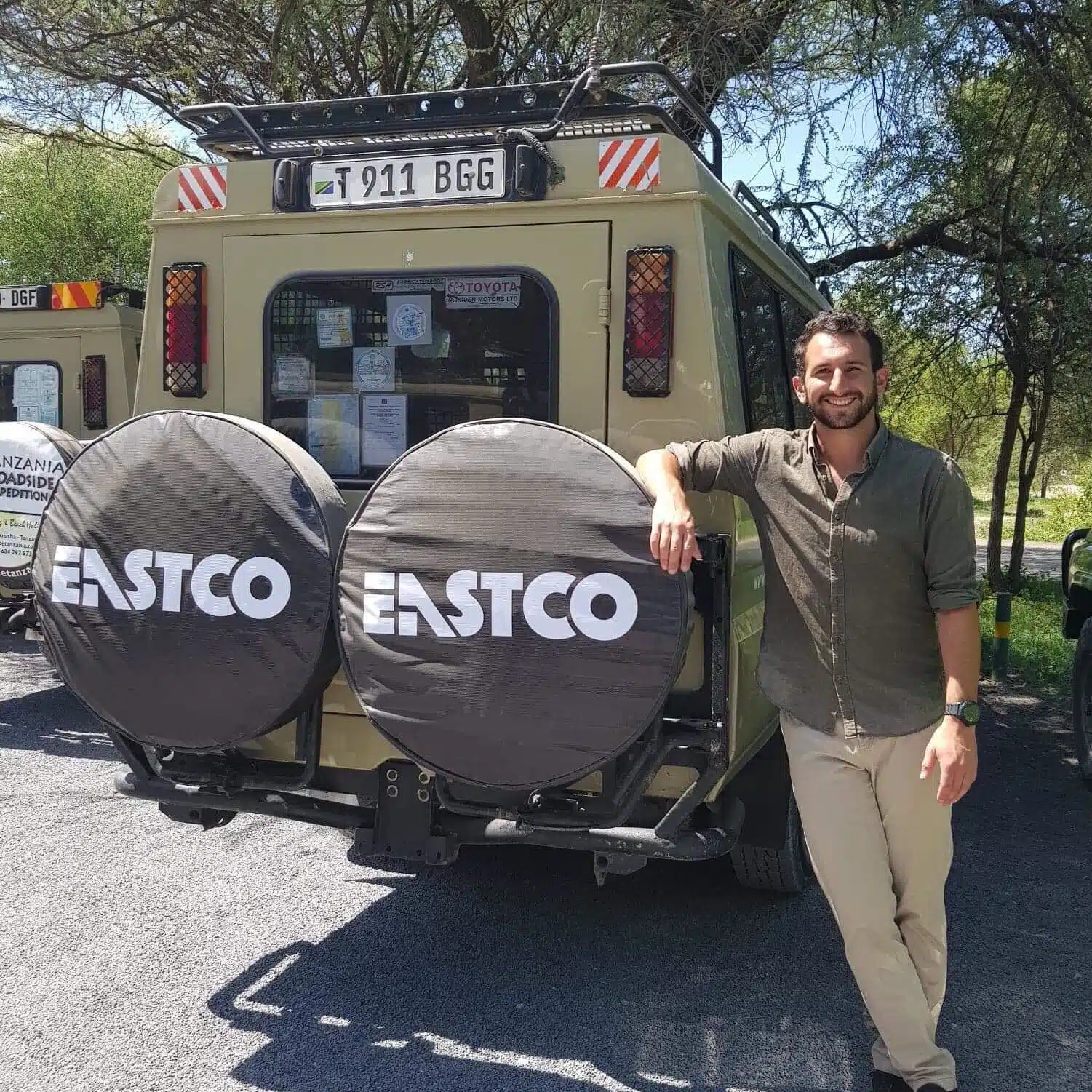
Ask how long guides normally remain with the company, what preparation they receive and whether the same guide stays with you throughout the route. Long-standing working relationships often tell you more than a vague promise of an “expert guide.” You can also meet some of EASTCO’s guides before deciding.
Vehicles and support
Comfort matters. Backup matters more.
Ask about seating, opening windows, charging, drinking water and luggage space. Then ask how vehicles are maintained, what communication equipment is carried and what happens if a mechanical problem occurs far from Arusha.
Compare like with like
Why two safari quotes can be very different
Old headline prices are not a useful way to compare safaris. Season, group size, camp location, room type, park fees and internal flights can change the cost considerably. Ask for a current, itemised proposal and compare what is actually included.
| Check | What to look for | Why it matters |
|---|---|---|
| Accommodation | Exact camp or lodge, room type and meal basis | A camp outside a park or far from the day’s wildlife area may be cheaper but adds driving. |
| Park fees | Park, conservation, concession and camping fees where applicable | These are a substantial part of a Tanzania safari and should not appear as a surprise later. |
| Vehicle | Private or shared, and where the private service begins and ends | A shared vehicle changes the pace and how decisions are made each day. |
| Flights and transfers | Airline, route, luggage allowance and airport transfers | A quote can appear cheaper simply because an important connection has been omitted. |
| Exclusions | Drinks, tips, visas, insurance and optional activities | Clear exclusions make meaningful comparison possible. |
4 The paperwork
Read the payment and cancellation terms
Before transferring money, check the deposit schedule, final-payment date, cancellation charges and the treatment of exchange-rate changes. Confirm whether the operator holds space before the deposit and when each camp becomes binding.
Travel arrangements sometimes change. Ask what happens if a scheduled flight moves, a camp cannot honour a booking or a park road becomes impassable. No operator can prevent every disruption; what matters is whether responsibility and communication are clear.
5 The evidence
Use reviews carefully
Recent independent reviews are useful, particularly when they repeatedly mention the guides, communication and the way problems were handled. Read the detailed reviews, not only the average score, and look at how the company responds when someone is unhappy.
A polished social-media feed proves very little about operations. Ask questions that require specific answers. A company that knows Tanzania should be able to explain the route, the trade-offs between camps and what is realistic for your dates without relying on sales language.
6 Local impact
Ask for examples, not sustainability slogans
Many operators use the same language about conservation and communities. Ask what the company actually does, where it works and how long those relationships have existed. Employment and guide retention also matter: local benefit begins with the people who run the safari every day.
EASTCO’s own relationship with the Maasai Steppe began before the company ran its first safari. The history includes farming, village relationships, camps and conservation work around Tarangire. We have set out that story on our community and conservation page, including the parts that developed over time.
How EASTCO answers these questions
A Tanzania operation since 1992
EASTCO is based in Arusha and has planned and operated private safaris since 1992. Our itineraries are starting points. The final route is adjusted for your dates, interests, group and current camp availability.
Many of our guide relationships go back years, and some go back to childhood. The company’s history is tied to guiding, camps and community relationships rather than a recently created marketing story.
Read why people travel with EASTCO, explore our history in Tanzania, or compare our private Tanzania safaris.
Keep this list
Questions worth sending before you book
- Who will operate the safari in Tanzania?
- Can I see the current tourism licence?
- Is the vehicle private throughout?
- Who employs the guide?
- Why were these camps chosen for my dates?
- What are the real driving times?
- Which park and conservation fees are included?
- Are flights and airport transfers included?
- What happens if a vehicle or flight is delayed?
- What are the payment and cancellation terms?
Frequently asked questions
Before choosing a Tanzania safari company
Should I book directly with a Tanzanian operator?
Booking directly can give you clearer contact with the people planning and operating the trip. An overseas specialist can also be valuable, especially when coordinating several countries. The important point is knowing who is responsible for each part and how the handover works.
Should I choose the cheapest safari quote?
Not until you have compared the camp locations, fees, vehicle arrangements, transfers and exclusions. A lower quote may be perfectly reasonable, but it should be clear where the saving comes from.
How far ahead should I book?
For busy migration months, Christmas, New Year and family rooms, earlier normally gives you more choice. A good safari can still be arranged closer to departure when dates and camp choices are flexible.
Can an operator guarantee wildlife or a river crossing?
No. Wildlife is wild, and migration movements depend heavily on rainfall. An experienced operator can choose the most sensible area for the season, but should not promise a particular sighting on a particular day.
A proposal should make sense before you pay
Ask us what works for your dates
Send us your dates, interests and the places you have in mind. Our safari team will explain what fits, what we would change and why. There is no obligation to book.